
5G RedCap, Satellite IoT, and the New Rules of Connectivity
The Internet of Things (IoT) continues to evolve rapidly, and the connectivity technologies that support it are entering a critical transformation. As legacy networks like 2G and 3G are sunsetted globally, new connectivity paradigms are emerging to meet the diverse needs of tomorrow’s connected devices—ranging from battery-powered sensors in agriculture to industrial robots in smart factories and asset trackers in the most remote parts of the planet.
In this article, we explore the key emerging technologies that every IoT innovator should pay attention to in 2026, explain why they’re game changers, and offer insights into how your business can future-proof its IoT connectivity strategy.
1. 5G RedCap: Bridging Performance with Practical Deployment
What is 5G RedCap?
5G Reduced Capability, commonly known as RedCap or NR-Light, is a variant of the 5G New Radio (NR) standard specifically tailored for IoT. It was introduced in 3GPP Release 17 to fill the gap between low-speed LPWAN technologies (like NB-IoT and LTE-M) and full 5G capable of multi-gigabit speeds. RedCap strips down unnecessary high-end radio complexity while keeping the performance benefits that matter for many IoT use cases.
Why RedCap Matters
Mid-Tier Sweet Spot: RedCap is ideal for devices that require moderate data rates (e.g., 10–150 Mbps), such as industrial sensors, video surveillance endpoints, wearables, and mobile tracking devices—without the cost and power penalties of full 5G modules.
Lower Cost & Power: By reducing antenna and RF chain complexity, RedCap enables simpler, more energy-efficient designs that are less expensive to manufacture and operate.
Industry Adoption: Analysts forecast that 5G and RedCap will drive nearly 50 % of carrier IoT connectivity revenues by 2030, underscoring its growing market reach.
Use Cases Accelerating Adoption
- Industrial Automation: Wireless sensors for manufacturing can use RedCap to stream richer telemetry and diagnostics data without needing full 5G.
- Wearables & Healthcare: Devices that require reliable connectivity and moderate bandwidth but have power and size constraints.
- Smart Infrastructure: Mid-range “connected city” assets, think environmental monitoring and parking sensors.
2. Satellite IoT & Non-Terrestrial Networks (NTN): Global Coverage Beyond Limits
What Are NTNs & Satellite IoT?
Non-Terrestrial Networks (NTNs) extend cellular connectivity into space using satellites (often in Low Earth Orbit—LEO—or geostationary orbits). Unlike traditional terrestrial networks, NTNs provide connectivity where cell towers don’t reach—deep seas, deserts, or polar regions, making them a foundational element for truly global IoT coverage.
Why Satellite IoT is a Game Changer
Global Reach: Whether tracking containers on an ocean crossing or monitoring remote pipelines, satellite IoT ensures devices remain connected even where terrestrial networks never existed.
Seamless Integration with Cellular: NTN support is now part of 3GPP standards, enabling devices to automatically switch between terrestrial and satellite links using the same underlying protocol stack.
Hybrid Connectivity: Modern IoT modules increasingly combine cellular and satellite radios, providing a single SKU that intelligently selects the best available network.
Use Cases Unlocked by NTN
- Logistics & Asset Tracking: Real-time visibility of shipments anywhere in the world.
- Agriculture & Environment: Sensors scattered across vast rangelands or wilderness areas.
- Utilities & Energy Assets: Monitoring remote infrastructure like pipelines, wind farms, and offshore platforms.
Real-World Examples
Companies like OQ Technology are deploying nanosatellite constellations offering standardized 3GPP NB-IoT and 5G NTN connectivity for IoT devices, bridging terrestrial coverage gaps with scalable satellite service.
3. LPWAN Evolution: NB-IoT, LTE-M, LoRaWAN & Beyond
While RedCap and NTNs get a lot of attention, Low Power Wide Area Networks (LPWAN) remain critical for IoT deployments where long battery life and low cost are priorities.
LPWAN Technologies
- NB-IoT (Narrowband IoT): A cellular-based LPWAN optimized for massive deployments of low-data, low-power devices.
- LTE-M: Higher throughput and mobility support compared to NB-IoT, appealing for mobile or mid-data applications.
- LoRaWAN: Unlicensed LPWAN with flexibility and long range, popular in private networks and smart cities.
Why LPWAN Still Matters
- Ultra-Low Power Consumption: Multi-year battery life on tiny coin cells.
- Cost-Effective at Scale: Modules and chips are inexpensive, critical for sensors numbering in the millions.
- Complementary to 5G: LPWAN technologies will continue coexisting with RedCap and NTN as part of a Tiered connectivity strategy.
4. Smart Hybrid Connectivity: The Connectivity Stack of the Futur
What Is Hybrid IoT Connectivity?
Future-proof IoT solutions will not rely on a single connectivity technology. Instead, they will blend cellular, LPWAN, and satellite links, managed intelligently to deliver optimal performance, cost, power efficiency, and reliability.
Key Capabilities
- Automatic Failover: Devices switch to satellite when cellular is unavailable.
- Multi-RAT Management: Device firmware and connectivity platforms orchestrate multiple radio access technologies.
- Global SIM/eSIM Profiles: Simplifies roaming and carrier management across borders.
5. Preparing Your IoT Strategy for the Next Decade
To future-proof your IoT deployments:
- Assess use-case requirements (latency, throughput, coverage, power) to select the right connectivity tech.
- Invest in modular, upgradable hardware supporting multi-mode radios.
- Build for flexibility: Combine RedCap, NB-IoT, and NTN where appropriate.
- Leverage carrier partnerships for global coverage and roaming plans.
Conclusion
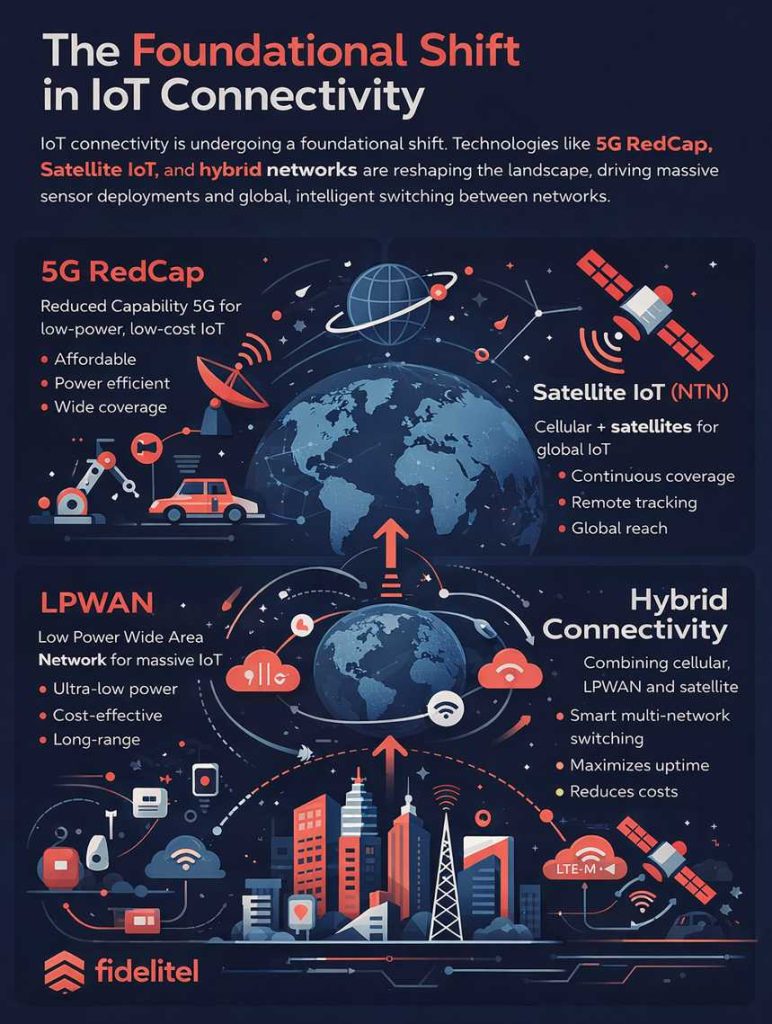
IoT connectivity is undergoing a foundational shift. Technologies like 5G RedCap are unlocking new performance tiers for practical IoT use cases, while Satellite IoT and NTNs are making truly global connectivity a reality. LPWAN continues to power the most massive sensor deployments, and hybrid connectivity architectures are enabling intelligent switching between networks to maximize uptime and cost efficiency.For businesses and developers, understanding these trends isn’t just about staying current, it’s about building IoT solutions that are resilient, scalable, and truly future-ready.