The future of IoT isn’t about choosing a single network, it’s about orchestrating multiple connectivity layers into one intelligent, adaptive system. As enterprises scale across factories, supply chains, and remote environments, the limitations of single-network architectures are becoming painfully clear.
This is where Hybrid IoT connectivity platforms emerge as the backbone of next-generation infrastructure, seamlessly switching between 5G, satellite, and LPWAN to guarantee uptime, performance, and global reach.
Why Hybrid IoT Is Becoming the Default Architecture
Traditional IoT deployments relied heavily on a single connectivity type, Wi-Fi, cellular, or LPWAN. But real-world environments are far more complex:
- Urban factories need ultra-low latency (5G)
- Remote sites need global reach (satellite)
- Battery-powered sensors need low energy (LPWAN)
No single network can satisfy all three.
The Shift to Multi-Network Intelligence
Modern connectivity platforms now integrate:
- 5G (public + private) → High bandwidth, ultra-low latency
- Satellite IoT → Global coverage, especially in remote or mobile environments
- LPWAN (LoRaWAN, NB-IoT, LTE-M) → Long-range, ultra-low power
This convergence enables:
- Always-on connectivity
- Automatic network failover
- Cost-optimized data routing
The industry is rapidly moving toward this model because hybrid architectures combine the strengths of each network while mitigating their weaknesses.
Understanding Each Connectivity Layer (And Its Role)
1. 5G: The High-Performance Backbone
5G is the engine behind real-time industrial intelligence.
- Ultra-low latency (milliseconds)
- Massive device density
- High throughput for video, AI, and robotics
In smart factories, private 5G enables:
- Real-time machine control
- Predictive maintenance
- Autonomous robotics and AGVs
Private 5G networks offer dedicated bandwidth, security, and customization, making them ideal for mission-critical industrial operations.
2. Satellite IoT: Coverage Without Limits
Satellite fills the biggest gap in IoT: coverage in remote and infrastructure-poor regions.
- Works in oceans, deserts, rural areas
- Enables asset tracking across global supply chains
- Supports disaster recovery and redundancy
Hybrid satellite-terrestrial systems ensure that even when terrestrial networks fail, connectivity persists, critical for uptime-sensitive operations.
3. LPWAN: The Scalable Sensor Layer
LPWAN is optimized for massive-scale, low-power deployments:
- Battery life measured in years
- Long-range communication
- Low data throughput
It’s ideal for:
- Environmental monitoring
- Smart metering
- Asset tracking
LPWAN enables millions of devices to operate efficiently, though with trade-offs in latency and bandwidth.
What Is a Hybrid IoT Connectivity Platform?
A Hybrid Connectivity Platform is a software-defined layer that:
- Manages multiple network types (5G, satellite, LPWAN)
- Dynamically selects the best available connection
- Provides unified visibility and control
Core Capabilities
- Network switching / failover
- SIM/eSIM orchestration
- Policy-based routing (cost vs performance)
- Real-time monitoring & analytics
- Security and identity management
Think of it as the “operating system” for connectivity.
Why Smart Factories Are Leading the Shift
Manufacturing is ground zero for hybrid IoT adoption.
The Problem with Traditional Connectivity
Factories typically rely on:
- Wi-Fi (unreliable in dense environments)
- Wired Ethernet (inflexible and costly)
- Public cellular (limited control)
These fail under:
- High device density
- Real-time requirements
- Mobility (robots, AGVs)
The Private 5G + Hybrid Platform Solution
Smart factories are adopting:
Private 5G + Hybrid Connectivity Platform
This enables:
- Real-time automation with guaranteed latency
- Seamless fallback to satellite or LPWAN
- Centralized control across all sites
Private 5G supports:
- Massive device connectivity
- Real-time analytics
- Secure, customizable networks
The Power of Intelligent Network Switching
One of the biggest innovations is dynamic network selection.
Example Scenario
A logistics company tracks containers globally:
- At port → connects via private/public 5G
- In transit (ocean) → switches to satellite
- Idle in storage → falls back to LPWAN
This ensures:
- Continuous tracking
- Optimized costs
- Minimal power consumption
Hybrid systems can achieve near-continuous uptime (>95–99%) in challenging environments.
Business Benefits of Hybrid IoT Platforms
1. Near-Zero Downtime
Always-on connectivity across multiple fallback networks
2. Cost Optimization
Use:
- 5G for high-value data
- LPWAN for low-cost telemetry
- Satellite only when needed
3. Global Scalability
Deploy anywhere without infrastructure constraints
4. Enhanced Security
Private 5G + centralized policy enforcement
5. Future-Proof Architecture
Easily integrate:
- Edge AI
- Digital twins
- Autonomous systems
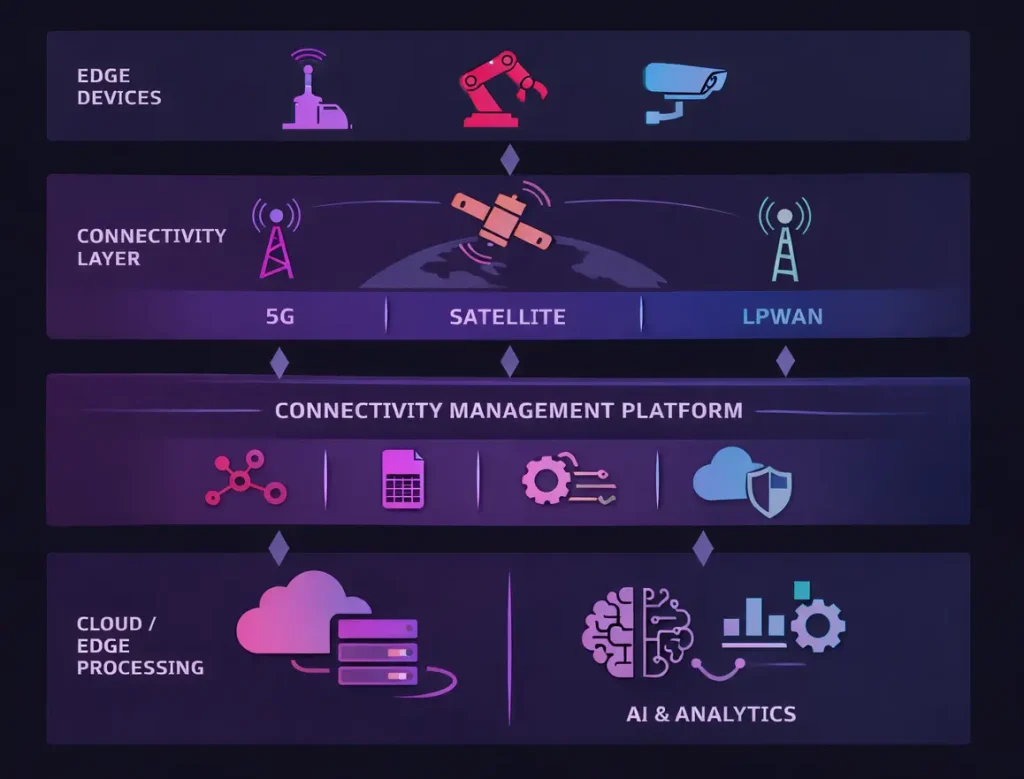
Architecture of a Hybrid IoT System
A typical deployment includes:
- Edge Devices — Sensors, cameras, machines
- Connectivity Layer — 5G / Satellite / LPWAN modules
- Connectivity Management Platform — Network orchestration, device provisioning, policy engine
- Cloud / Edge Processing — AI analytics, digital twins, automation systems
Future Trends: Where Hybrid IoT Is Heading
1. eSIM + iSIM Standardization
Devices will dynamically switch carriers/networks globally
2. AI-Driven Connectivity
Platforms will automatically optimize:
- Latency
- Cost
- Bandwidth
3. 5G + Satellite Convergence (NTN)
5G standards are integrating satellite directly into cellular ecosystems
4. Edge-Native Architectures
Processing moves closer to devices for real-time decisions
Final Takeaway
Hybrid IoT isn’t just a trend, it’s becoming the default architecture for resilient, global, and scalable connectivity.
- 5G delivers performance
- Satellite ensures reach
- LPWAN enables scale
- Connectivity platforms unify everything
For smart factories and industrial enterprises, the shift is clear:
👉 From single-network dependency
👉 To intelligent, software-defined multi-connectivity
The result?
Always-on operations, real-time intelligence, and true Industry 4.0 at scale.