A Practical Guide for Global IoT and Connected Device Deployments
In today’s hyper-connected digital economy, reliable cellular connectivity is the backbone of modern devices. From IoT sensors and smart meters to connected vehicles, logistics trackers, and retail devices, millions of devices rely on cellular networks to stay online.
However, deploying connected devices globally introduces one major challenge: network availability and reliability across regions and operators.
Traditional SIM cards were designed for consumer mobile phones, usually tied to a single carrier in a single country. But global deployments require something more flexible.
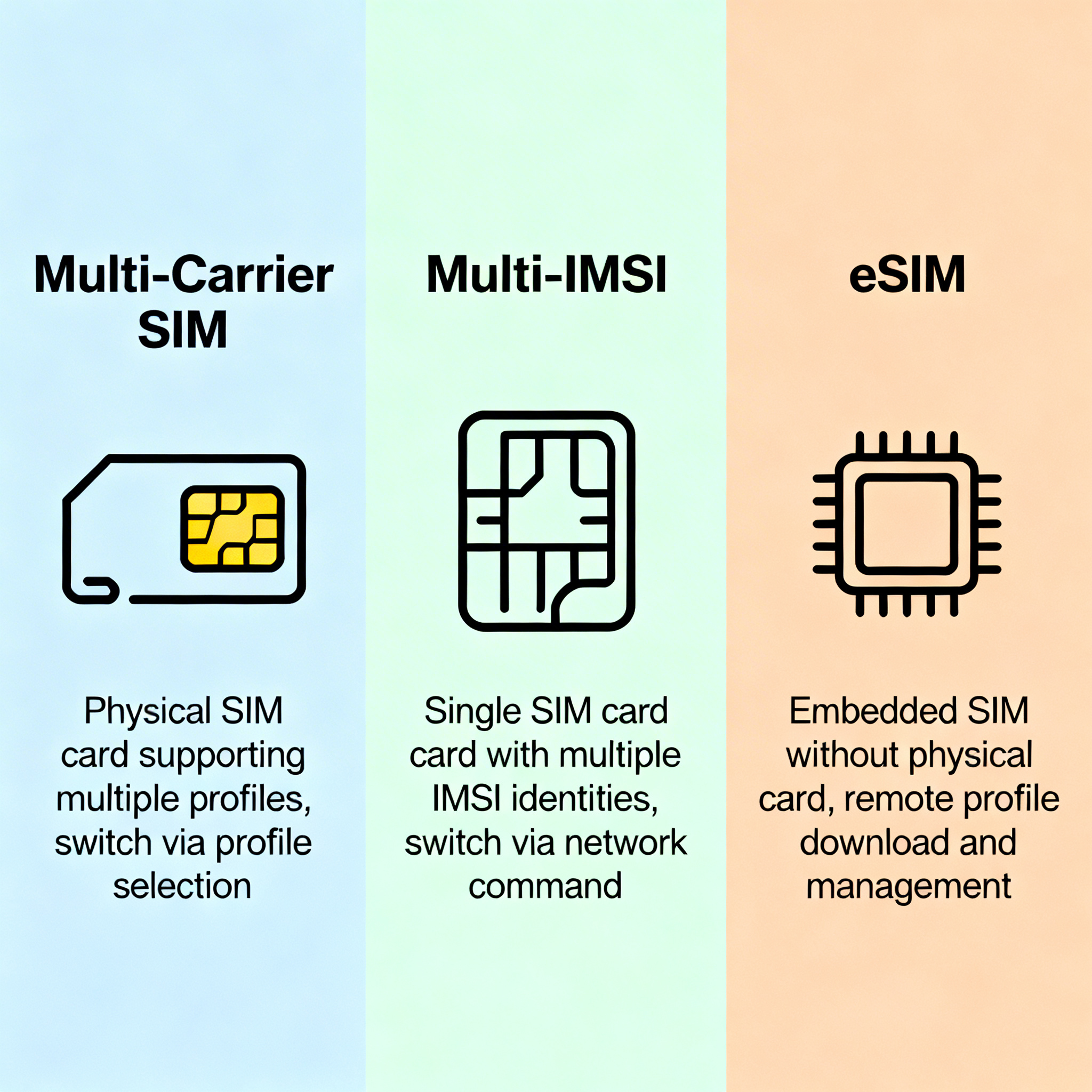
To address this challenge, the telecom and IoT industries have developed several new SIM technologies:
- Multi-Carrier SIM (Roaming SIM)
- Multi-IMSI SIM
- eSIM / eUICC
While these technologies are often discussed interchangeably, they operate very differently under the hood. Understanding these differences is critical for businesses deploying connected devices across multiple regions.
This article provides a comprehensive, practical guide to these three SIM technologies, including how they work, their advantages and limitations, and real-world deployment scenarios.
Why SIM Technology Matters for Global Connectivity
Every cellular device requires a SIM (Subscriber Identity Module) to authenticate with a mobile network. The SIM stores credentials such as the IMSI (International Mobile Subscriber Identity) that uniquely identifies the subscriber on the network.
Traditional SIMs were designed with a single operator relationship, meaning:
- One SIM
- One carrier
- One network identity
This works well for smartphones, but it becomes problematic for large-scale connected device deployments.
Challenges include:
- Inconsistent coverage across networks
- Devices moving across countries
- Regulatory restrictions on permanent roaming
- Carrier lock-in
- Cost inefficiencies
To solve these issues, connectivity providers developed advanced SIM architectures that allow devices to connect to multiple networks or switch carriers dynamically.
The three most common approaches today are Multi-Carrier SIM, Multi-IMSI SIM, and eSIM / eUICC.
1. Multi-Carrier SIM (Roaming SIM)
What Is a Multi-Carrier SIM?
A Multi-Carrier SIM, often called a roaming SIM, is a SIM issued by one primary mobile network operator (or IoT connectivity provider) that can connect to partner networks through international roaming agreements.
Instead of being limited to one operator, the SIM can attach to multiple networks depending on location and signal strength.
However, technically the device is still roaming outside the SIM’s home network.
How Multi-Carrier SIMs Work
A roaming SIM typically contains:
- One primary IMSI
- A home network operator
- Access to roaming partner networks
When the device connects:
- The SIM attempts to connect to the home network identity
- If unavailable, it roams onto partner networks
- The network selection is controlled through roaming agreements and policies
This allows a single SIM to work across multiple networks globally.
Example Deployment
Imagine a fleet tracking device used globally.
The device is shipped with a roaming SIM issued by a connectivity provider.
When deployed:
- In Germany → connects to Deutsche Telekom
- In Brazil → connects to Claro
- In Japan → connects to NTT Docomo
- In Canada → connects to Rogers
The same SIM works everywhere, but the device is technically roaming outside the home operator.
Advantages of Multi-Carrier SIM
✔ Simple global deployments
✔ One SIM SKU for multiple countries
✔ Faster time to market
✔ No physical SIM swapping
✔ Works with existing roaming infrastructure
Limitations
Despite its convenience, roaming SIMs have several limitations:
- Permanent Roaming Restrictions — Some countries restrict devices that permanently roam on foreign operators.
- Lower Network Priority — Roaming devices may receive lower network priority than local subscribers, especially during congestion.
- Higher Connectivity Costs — Roaming agreements can increase operational costs compared to local connectivity.
- Limited Control — Switching carriers often depends on the home operator’s roaming agreements, not the enterprise.
2. Multi-IMSI SIM
What Is a Multi-IMSI SIM?
A Multi-IMSI SIM contains multiple IMSI identities stored on a single SIM card, allowing the device to switch between them depending on location, signal quality, or predefined policies.
Each IMSI represents a different operator subscription.
Instead of roaming, the SIM can activate a local identity for the network it connects to.
How Multi-IMSI SIMs Work
A Multi-IMSI SIM includes:
- Multiple preloaded IMSI profiles
- A bootstrap identity for initial connectivity
- Policy rules for switching networks
The SIM automatically switches identities when needed.
Example switching logic:
- Signal quality
- Network availability
- Geographic location
- Data cost optimization
This allows the device to behave like a local subscriber instead of a roaming device.
Example Deployment
Consider a smart utility meter deployed globally.
The SIM may include:
- IMSI 1 → AT&T identity for the United States
- IMSI 2 → Telefonica identity for Spain
- IMSI 3 → Vodafone identity for the UK
When the device moves between regions, it activates the most appropriate IMSI.
Advantages of Multi-IMSI SIM
✔ Improved network reliability
✔ Reduced roaming dependency
✔ Higher network priority (local identity)
✔ Better latency and performance
✔ Works in markets restricting permanent roaming
Limitations
Despite its advantages, Multi-IMSI also has constraints.
- Profiles Are Pre-Loaded — The SIM can only switch between identities already stored on the SIM.
- Limited Post-Deployment Flexibility — Adding new carriers later may require OTA updates or SIM replacement.
- Proprietary Implementations — Multi-IMSI technology is not governed by a universal standard, meaning implementations vary by provider.
3. eSIM / eUICC
What Is eSIM?
An eSIM (embedded SIM) is a SIM chip embedded directly into the device hardware rather than inserted as a removable card.
However, the real breakthrough behind eSIM technology is eUICC.
What Is eUICC?
eUICC (Embedded Universal Integrated Circuit Card) is the software architecture that enables Remote SIM Provisioning (RSP).
This means operator profiles can be downloaded, activated, or changed remotely over-the-air.
Unlike traditional SIM cards, eUICC allows devices to store multiple operator profiles and switch between them without replacing the SIM.
How eSIM / eUICC Works
An eUICC ecosystem typically includes:
- Bootstrap profile — Initial network connection.
- Remote SIM provisioning platform
- Profile download and installation
- Network activation
Profiles are managed using secure infrastructure such as:
- SM-DP (Subscription Manager Data Preparation)
- SM-SR (Subscription Manager Secure Routing)
These systems securely deliver operator profiles to the device.
Example Deployment
Imagine a global smart logistics tracker.
When manufactured, it ships with:
- One bootstrap connectivity profile
When deployed:
- In the United States → downloads AT&T profile
- In Europe → downloads Vodafone profile
- In Asia → downloads NTT profile
Profiles can be added, removed, or replaced remotely.
Advantages of eSIM / eUICC
✔ Remote SIM provisioning
✔ Carrier independence
✔ Unlimited profile management
✔ Future-proof connectivity
✔ No physical SIM access required
✔ Ideal for sealed or industrial devices
Limitations
- Higher Initial Infrastructure Cost — Deploying eUICC requires integration with remote provisioning platforms.
- Implementation Complexity — Integrating with operator profile systems can take longer compared to simpler SIM models.
- Industry Adoption Still Growing — While rapidly expanding, eSIM adoption across all operators is still evolving.
Key Differences Between the Three SIM Technologies
| Feature | Multi-Carrier SIM | Multi-IMSI SIM | eSIM / eUICC |
|---|---|---|---|
| Network Access | Roaming agreements | Multiple local identities | Remote operator profiles |
| IMSI Profiles | Single | Multiple | Multiple downloadable |
| Network Switching | Roaming selection | IMSI switching | Remote profile download |
| Roaming Dependency | High | Low | Optional |
| Post-Deployment Flexibility | Limited | Moderate | Very High |
| Standards | Traditional SIM | Proprietary | GSMA standardized |
Practical Use Cases
IoT Device Deployments
For large IoT networks:
- Multi-Carrier SIM → simple cross-border deployments
- Multi-IMSI SIM → improved reliability and coverage
- eSIM / eUICC → scalable global connectivity
Fleet and Logistics Tracking
Devices moving across countries benefit from:
- Multi-carrier roaming coverage
- Multi-IMSI for regional optimization
- eUICC for carrier switching
Smart Infrastructure
Devices installed in remote locations, such as:
- Smart meters
- Industrial monitoring systems
- energy infrastructure
often benefit from eSIM because profiles can be updated remotely without physical access.
Consumer Devices
Smartphones increasingly use eSIM technology, allowing users to activate carrier plans digitally without inserting a physical SIM card.
Choosing the Right SIM Technology
Selecting the best option depends on deployment scale, geographic reach, and operational requirements.
Multi-Carrier SIM
Best for:
- Rapid international deployment
- Early stage IoT projects
- Low-complexity connectivity needs
Multi-IMSI SIM
Best for:
- Regional deployments
- Connectivity redundancy
- Higher uptime requirements
eSIM / eUICC
Best for:
- Large-scale global IoT
- Long device lifecycles
- Carrier independence
- Future-proof connectivity strategies
The Future of SIM Connectivity
The evolution of SIM technology reflects the growing need for flexible, resilient connectivity infrastructure.
Key industry trends include:
- Remote connectivity management
- Multi-network resilience
- Device lifecycle connectivity control
- global IoT scalability
As IoT deployments expand across industries, from logistics to fintech to smart infrastructure, flexible SIM architectures will become a core requirement for connected device ecosystems.
Technologies like Multi-IMSI and eUICC represent the next stage in cellular connectivity, enabling devices to remain connected regardless of geography, operator availability, or network conditions.
Final Thoughts
Understanding the differences between Multi-Carrier SIM, Multi-IMSI SIM, and eSIM / eUICC is essential for organizations deploying connected devices at scale.
Each technology solves connectivity challenges in a different way:
- Multi-Carrier SIM simplifies roaming across networks
- Multi-IMSI SIM improves reliability by switching identities
- eSIM / eUICC enables dynamic carrier management and long-term scalability
For global deployments, the future increasingly points toward eUICC-enabled connectivity platforms that combine remote provisioning with multi-network resilience.
This shift will allow organizations to deploy devices anywhere in the world while maintaining control, flexibility, and reliability in their connectivity infrastructure.