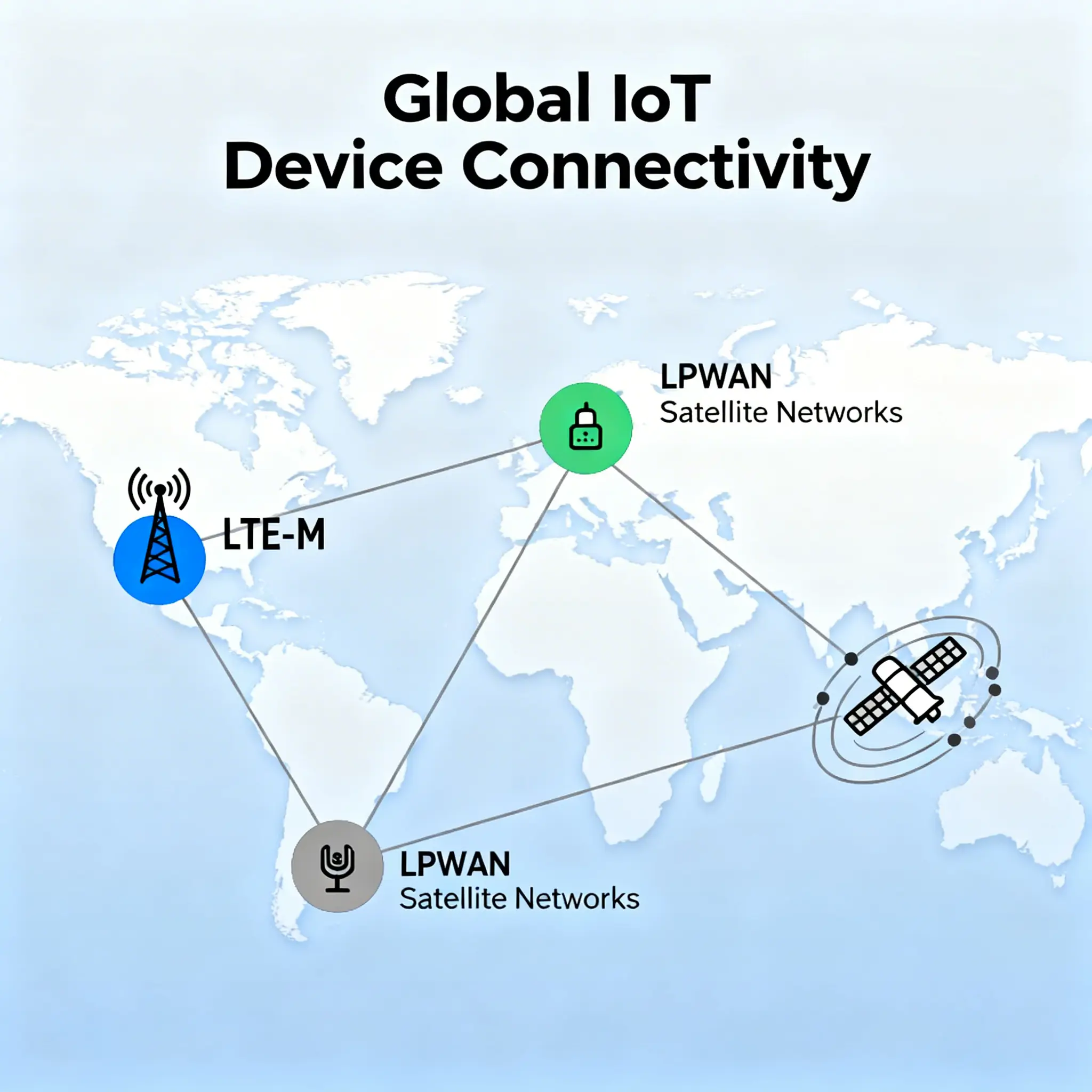
Architecture, Technologies, eSIM, eUICC, and Global Deployment Strategies
Why IoT Connectivity Is Becoming Critical Infrastructure
Over the past decade, the Internet of Things (IoT) has transformed from a niche technology into a foundational layer of global digital infrastructure.
From logistics tracking and smart energy grids to connected vehicles and industrial automation, organizations now rely on connected devices to collect data, automate operations, and deliver new services.
Industry forecasts estimate that over 30 billion IoT devices will be deployed worldwide by 2030.
But as deployments scale globally, enterprises face a critical challenge:
How do you connect millions of devices reliably, securely, and cost-effectively across multiple networks and countries?
Connectivity is no longer a simple telecom function. It has become a strategic infrastructure layer that determines whether IoT deployments succeed or fail.
This guide explores the technologies, standards, and architectures that power modern IoT connectivity, including:
- Cellular IoT technologies
- Multi-network connectivity
- eSIM and eUICC architecture
- GSMA compliance standards
- eIM orchestration platforms
- Global deployment strategies
What Is IoT Connectivity?
IoT connectivity refers to the network technologies that allow devices to communicate with cloud platforms, applications, and other devices.
Unlike traditional mobile connectivity designed for smartphones, IoT connectivity must support:
- billions of devices
- low power consumption
- remote deployment environments
- long device lifecycles
- high security requirements
Connectivity options include several technologies, each designed for specific use cases.
The Major Types of IoT Connectivity
Cellular IoT
Cellular connectivity remains the most widely used technology for large-scale IoT deployments.
It provides:
- global coverage
- high reliability
- strong security infrastructure
- support for mobility
Major cellular IoT technologies include:
LTE-M
Low-power LTE designed for IoT devices requiring mobility and moderate data transmission.
Common use cases:
- asset tracking
- wearables
- fleet management
NB-IoT
Narrowband IoT is optimized for ultra-low power consumption and low data transmission.
Typical applications:
- smart meters
- environmental sensors
- infrastructure monitoring
5G IoT
5G introduces advanced capabilities such as:
- ultra-low latency
- massive device density
- high data throughput
However, many IoT deployments still rely on LTE-based technologies due to cost and coverage considerations.
LPWAN (Low-Power Wide Area Networks)
LPWAN technologies enable long-range communication with minimal power consumption.
Examples include:
- LoRaWAN
- Sigfox
These technologies are commonly used for sensor networks but lack the global roaming flexibility of cellular networks.
Satellite IoT
Satellite connectivity enables IoT deployments in remote areas where terrestrial networks are unavailable.
Industries such as maritime, agriculture, and mining rely on satellite connectivity for remote operations.
Why Cellular IoT Dominates Global Deployments
Despite multiple connectivity options, cellular networks remain the preferred infrastructure for large-scale IoT deployments.
Key reasons include:
- Global Coverage: Mobile operators provide extensive coverage across countries and regions.
- Mobility Support: Cellular networks support moving devices such as vehicles and shipping containers.
- Strong Security: Mobile networks rely on SIM-based authentication and encryption.
- Standardized Infrastructure: Telecom standards ensure interoperability across devices and operators.
The Role of SIM Technology in IoT
Connectivity in cellular networks is enabled by SIM technology.
SIM cards authenticate devices and provide network credentials.
However, traditional SIM cards introduce several challenges in IoT environments:
- physical installation
- operator lock-in
- costly replacements
- complex global logistics
To overcome these limitations, the telecom industry introduced eSIM and eUICC technology.
Understanding eSIM and eUICC
What Is eSIM?
An eSIM (embedded SIM) allows network profiles to be downloaded and managed remotely.
Instead of physically replacing SIM cards, connectivity profiles can be installed over the air.
This enables:
- remote activation
- network switching
- simplified logistics
What Is eUICC?
The eUICC (embedded Universal Integrated Circuit Card) is the secure chip embedded in IoT devices that stores multiple network profiles.
It enables remote SIM provisioning and supports dynamic network switching.
Key capabilities include:
- multiple operator profiles
- remote installation and deletion
- secure profile storage
- OTA updates
GSMA Standards and eSIM Compliance
The global mobile ecosystem relies on standards defined by the GSM Association.
These standards ensure interoperability between:
- device manufacturers
- network operators
- connectivity platforms
Important eSIM specifications include:
- SGP.22 – Consumer eSIM architecture.
- SGP.02 – Machine-to-Machine eSIM architecture.
- SGP.32 – Next-generation IoT eSIM architecture.
The New IoT Architecture: eSIM IoT Manager (eIM)
One of the most significant developments in IoT connectivity is the introduction of the eSIM IoT Manager (eIM).
The eIM acts as a central orchestration platform for managing connectivity across device fleets.
Functions include:
- remote profile installation
- profile switching
- subscription lifecycle management
- connectivity policy enforcement
This architecture enables organizations to manage millions of devices remotely.
Core Components of the eSIM Ecosystem
The eSIM ecosystem consists of several critical components.
- eUICC Hardware: Secure embedded chip inside devices.
- SM-DP+: Subscription Manager Data Preparation platform responsible for profile creation and delivery.
- SM-SR: Subscription Manager Secure Routing (used in M2M architecture).
- eIM: Central orchestration platform introduced in the latest IoT architecture.
Why GSMA Compliance Matters
A GSMA-compliant eSIM platform must meet strict security and interoperability requirements.
These include:
- SAS-certified manufacturing
- Common Criteria security certification
- PKI authentication
- trusted profile formats
Compliance ensures that devices can operate securely across global mobile networks.
Risks of Non-Compliant eSIM Platforms
Non-compliant solutions may introduce major risks.
These include:
- Vendor Lock-In: Devices become permanently tied to a specific operator.
- Security Vulnerabilities: Improper encryption may expose network credentials.
- Limited Interoperability: Devices may fail to connect across different carriers.
Enterprise IoT Use Cases
Modern IoT connectivity supports numerous industries.
- Logistics: Global asset tracking and fleet management.
- Smart Energy: Remote management of millions of meters.
- Fintech: Reliable connectivity for POS terminals.
- Industrial IoT: Factory automation and equipment monitoring.
- Maritime: Connectivity for ships and offshore platforms.
The Future of IoT Connectivity
The next generation of IoT infrastructure will be defined by:
- automated connectivity management
- multi-network architectures
- eSIM lifecycle orchestration
- AI-driven network optimization
Organizations that adopt these technologies early will gain significant competitive advantages.
Conclusion
IoT connectivity has evolved from a simple telecom function into a strategic digital infrastructure layer.
Technologies such as eSIM, eUICC, and eIM are enabling organizations to deploy connected devices globally with unprecedented flexibility and scalability.
For enterprises building global IoT solutions, understanding the architecture and standards behind connectivity is essential to long-term success.