
Why LPWAN Connectivity Matters
As IoT deployments scale from thousands to millions of devices, connectivity becomes a strategic decision, not just a technical one. Enterprises must balance power consumption, coverage, cost, mobility, security, and Quality of Service (QoS).
Low-Power Wide-Area Network (LPWAN) technologies were designed specifically to meet these requirements, enabling long battery life, wide coverage, and cost-efficient connectivity for massive IoT deployments.
In this guide, Fidelitel provides an enterprise-grade comparison of NB-IoT, LTE-M, LoRaWAN, Sigfox, and other LPWAN technologies, helping solution architects, OEMs, and business leaders choose the right connectivity model.
What Is LPWAN?
LPWAN refers to wireless technologies optimized for:
- Very low power consumption (10+ year battery life)
- Long-range communication
- Low data throughput
- High device density
LPWAN solutions generally fall into two categories:
| Category | Examples | Spectrum |
| Cellular LPWAN | NB-IoT, LTE-M | Licensed |
| Non-Cellular LPWAN | LoRaWAN, Sigfox | Unlicensed |
NB-IoT (Narrowband IoT
NB-IoT (Narrowband Internet of Things) is a 3GPP-standardized cellular LPWAN technology purpose-built for massive-scale, low-data-rate, static IoT deployments. It operates in licensed cellular spectrum and is optimized for devices that transmit small amounts of data infrequently, often from hard-to-reach locations such as basements, underground vaults, or dense urban environments.
NB-IoT leverages existing LTE and 5G infrastructure, allowing mobile network operators to support IoT traffic without deploying new radio networks. Its narrow bandwidth and simplified device complexity enable ultra-low power consumption and long device lifecycles, making it ideal for utility-grade and infrastructure-centric IoT applications.
Key Features Explained
- Licensed Cellular Spectrum: Ensures predictable performance, reduced interference, and carrier-grade reliability.
- Ultra-Narrow Bandwidth (180 kHz): Optimized for small payloads, enabling efficient spectrum usage.
- Deep Indoor & Underground Coverage: Link budget improvements of up to +20 dB over GSM allow connectivity in basements and meter pits.
- Power Saving Mode (PSM) & eDRX: Devices can sleep for extended periods, supporting 10–15 year battery life.
- High Device Density: Supports tens of thousands of devices per cell, ideal for massive IoT.
- SIM-Based Security: Uses standard LTE authentication and encryption mechanisms.
Best Use Cases (Why NB-IoT Fits)
- Smart Metering: Water, gas, and electricity meters requiring long life and deep indoor reach.
- Smart Cities: Parking sensors, waste bins, environmental monitoring nodes.
- Utilities & Infrastructure: Pipeline monitoring, manhole sensors, leak detection.
- Industrial IoT: Remote condition monitoring where data is periodic and non-time-critical.
Benefits
- Exceptional signal penetration
- Long battery life and low maintenance
- Secure, standardized, and scalable
Pros & Cons
Pros
- Excellent indoor coverage
- Low module and operating cost
- Strong security and reliability
Cons
- Limited support for mobility
- Higher latency
- Not suitable for real-time or high-bandwidth applications
LTE-M (LTE Cat-M1)
Overview
LTE-M (also known as Cat-M1) is a cellular LPWAN technology designed to support mobile, latency-sensitive, and moderately data-intensive IoT applications. Unlike NB-IoT, LTE-M supports full mobility and seamless handovers between cells, making it suitable for devices that move frequently or require near-real-time communication.
LTE-M strikes a balance between power efficiency and performance, enabling applications that need higher data rates, lower latency, or even voice services, while still maintaining extended battery life compared to traditional LTE.
Key Features Explained
- Licensed Spectrum & LTE Infrastructure: Provides consistent QoS and nationwide/global coverage.
- Higher Data Rates: Supports firmware updates, richer telemetry, and diagnostics.
- Full Mobility & Handover: Devices remain connected while moving across cells.
- Low Latency: Suitable for time-sensitive IoT use cases.
- VoLTE Support: Enables voice communication for wearables and emergency devices.
- SIM-Based Authentication: Secure, operator-managed connectivity.
Best Use Cases (Why LTE-M Fits)
- Asset & Fleet Tracking: Vehicles, containers, and mobile equipment.
- Wearables & Connected Health: Medical monitors, emergency alert devices.
- Logistics & Supply Chain: Real-time shipment monitoring.
- Smart Retail & POS: Kiosks, vending machines, digital signage.
Benefits
- Reliable connectivity for moving devices
- Supports richer data and voice
- Strong global roaming ecosystem
Pros & Cons
Pros
- Best LPWAN choice for mobility
- Lower latency than NB-IoT
- Supports voice and OTA updates
Cons
- Higher power consumption than NB-IoT
- Slightly higher module cost
LoRaWAN
LoRaWAN is a non-cellular LPWAN protocol built on LoRa radio modulation, operating in unlicensed ISM spectrum. It is designed for long-range, ultra-low-power communication and enables organizations to deploy private, public, or community-owned IoT networks.
LoRaWAN is particularly attractive for use cases where enterprises want full control over their network infrastructure, data ownership, and coverage footprint, without relying on cellular operators.
Key Features Explained
- Unlicensed Spectrum: No SIMs or operator dependency; flexible deployment models.
- Very Long Range: Up to 15+ km in rural areas and several kilometers in urban environments.
- Ultra-Low Power Consumption: End devices can operate for 10+ years on battery.
- Star-of-Stars Architecture: Simple device-to-gateway communication model.
- Small Payload Optimization: Best for infrequent sensor data.
Best Use Cases (Why LoRaWAN Fits)
- Smart Agriculture: Soil moisture, weather stations, livestock monitoring.
- Smart Cities: Street lighting, parking, air quality monitoring.
- Industrial Campuses: Factories, ports, and mining operations.
- Remote Environmental Monitoring: Forests, water bodies, and rural infrastructure.
Benefits
- Full control and ownership of network
- Very low operating cost
- Excellent range and battery life
Pros & Cons
Pros
- Private network capability
- Low hardware cost
- Long device lifespan
Cons
- No guaranteed QoS
- Limited scalability under heavy traffic
- Not suitable for mobile or real-time use cases
Sigfox
Sigfox is a proprietary LPWAN technology focused on ultra-low bandwidth and ultra-low power communication. It is optimized for extremely simple IoT devices that send very small messages a limited number of times per day.
Sigfox operates on a global, operator-managed network model, making it easy to deploy devices without building infrastructure, but with trade-offs in flexibility and data capability.
Key Features Explained
- Ultra-Narrowband Technology: Minimizes energy use and interference.
- Unlicensed Spectrum: Operates globally with low device complexity.
- Operator-Managed Network: No private deployment option.
- Very Small Payload Sizes: Typically a few bytes per message.
- Low Energy Consumption: Ideal for long battery life.
Best Use Cases (Why Sigfox Fits)
- Simple Status Sensors: Tamper alerts, door open/close sensors.
- Basic Asset Presence Tracking: Location presence, not real-time tracking.
- Alarm & Alert Systems: Infrequent, event-driven communication.
Pros & Cons
Pros
- Extremely low power usage
- Simple and low-cost devices
Cons
- Very limited data throughput
- Vendor lock-in
- Limited bidirectional communication
Feature-by-Feature Comparison
| Feature | NB-IoT | LTE-M | LoRaWAN | Sigfox |
| Spectrum | Licensed | Licensed | Unlicensed | Unlicensed |
| Mobility | Low | High | None | None |
| Data Rate | Low | Medium | Very Low | Ultra Low |
| Latency | High | Low | High | Very High |
| Battery Life | 10+ Years | 5–10 Years | 10+ Years | 10+ Years |
| QoS | Carrier-grade | Carrier-grade | Best-effort | Best-effort |
| Security | LTE-grade | LTE-grade | Network-dependent | Proprietary |
| Deployment | Public cellular | Public cellular | Private/Public | Public only |
Cost & Quality of Service (QoS)
Cost Considerations
- NB-IoT & LTE-M: SIM fees, operator subscriptions, but predictable QoS
- LoRaWAN: Low operating costs, higher upfront gateway investment
- Sigfox: Low device cost, recurring network fees
QoS Comparison
- Cellular LPWAN offers guaranteed performance, SLA-backed uptime, and roaming
- Unlicensed LPWAN operates on best-effort basis with potential interference
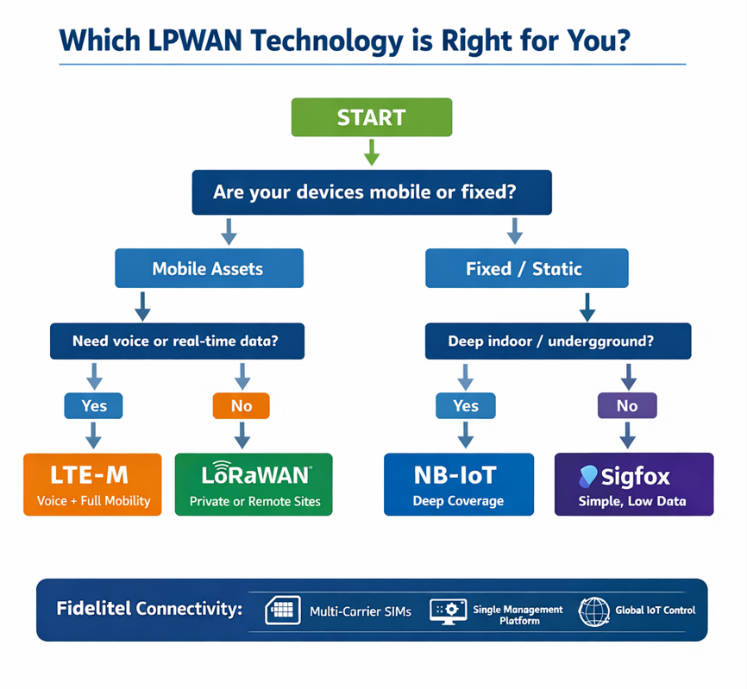
LPWAN Decision Tree: Choose the Right Technology in 60 Seconds
Use the quick decision flow below to narrow down the right LPWAN option for your deployment. This framework helps enterprises rapidly align technical requirements with business objectives before deeper architectural design:
How Fidelitel Enables LPWAN at Enterprise Scale
Deploying LPWAN technologies such as NB-IoT and LTE-M at scale requires far more than radio coverage. Enterprise success depends on resilience, governance, security, lifecycle management, and global consistency. Fidelitel delivers LPWAN as a managed, carrier-agnostic service, purpose-built for mission-critical IoT deployments.
Fidelitel’s architecture eliminates the limitations of single-carrier LPWAN by combining multi-carrier SIM technology, fixed IP connectivity, centralized orchestration, and enterprise-grade security, enabling organizations to scale from pilot to millions of devices with confidence.
Fidelitel’s LPWAN Control Layer (What Makes Us Different)
At the core of Fidelitel’s LPWAN offering is a Unified Connectivity Control Layer that abstracts carrier complexity and gives enterprises full operational control.
Key Capabilities
- Multi-Carrier NB-IoT & LTE-M Access
Automatically connects devices to the strongest available carrier per location, eliminating coverage gaps and roaming lock-in. - Single SIM, Global Footprint
One SIM SKU supports NB-IoT and LTE-M across regions, no re-provisioning, no SKU fragmentation. - Fixed IP & Private Routing
Enables secure, deterministic access to devices for utilities, smart infrastructure, and regulated industries. - Centralized Policy & Lifecycle Management
Provision, suspend, migrate, and see every LPWAN device globally from one console.
Enterprise-Grade Security Built for LPWAN
LPWAN devices often operate unattended for a decade or more. Fidelitel embeds security at every layer.
Security by Design
- Private APNs & Fixed IP Routing
- Network-level firewalls & traffic isolation
- Carrier-independent redundancy
- No public internet exposure by default
- Compliance-ready architecture (utilities, municipalities, infrastructure)
Why Enterprises Choose Fidelitel for LPWAN
| Challenge | Single-Carrier LPWAN | Fidelitel LPWAN |
|---|---|---|
| Coverage gaps | Common | Eliminated via multi-carrier |
| Vendor lock-in | High | Carrier-agnostic |
| Global scaling | Complex | One SIM, one platform |
| Network outages | Single point of failure | Built-in redundancy |
| Security | Basic | Fixed IP + private routing |
| Ops overhead | High | Centralized SPOG |
The Fidelitel Promise
Fidelitel doesn’t just provide LPWAN connectivity, we provide LPWAN certainty.
“From pilot to nationwide rollout, Fidelitel ensures your NB-IoT and LTE-M deployments remain secure, resilient, and future-proof, no matter how carriers, standards, or geographies evolve.”