The next evolution of IoT connectivity is no longer theoretical. Direct-to-Device (D2D) satellite communication is moving from early pilots to commercial reality, and it’s creating confusion in the market.
At Fidelitel, we help IoT businesses navigate connectivity transitions with clarity. This guide breaks down what Direct-to-Device (D2D) IoT actually means, how it differs from standards-based NTN, what’s available now, and what businesses should do next.
What Is Direct-to-Device (D2D)?
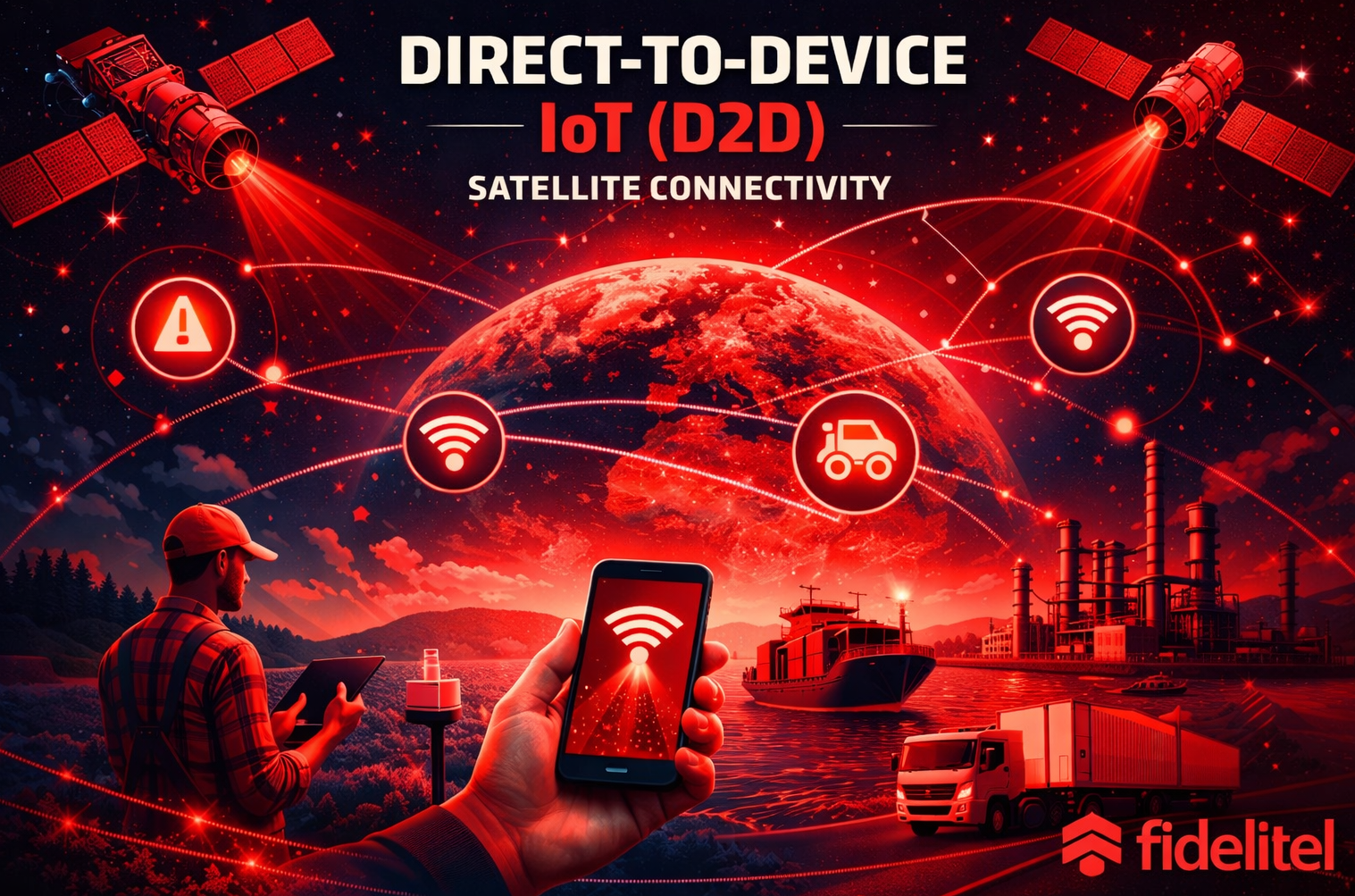
Direct-to-Device (D2D) refers to satellite systems that communicate directly with standard mobile devices or IoT hardware, without requiring traditional satellite terminals or large external antennas.
Instead of connecting to a ground-based cell tower, the device connects directly to a satellite in orbit.
Unlike legacy satellite IoT systems (which required bulky hardware), D2D leverages modified or standards-aligned cellular spectrum to reach devices on Earth.
What Direct-to-Device (D2D) Really Means
D2D does not automatically mean:
- Universal compatibility with all phones
- Full broadband speeds
- Replacement of cellular networks
- Immediate hardware-free IoT deployments
It means:
- Satellites act as cell towers in the sky
- Devices may communicate using cellular spectrum
- Coverage can extend beyond terrestrial infrastructure
- It is primarily optimized for low-bandwidth messaging, alerts, and IoT telemetry
How Does D2D Work?
D2D technology is built on three core components:
1️⃣ Low Earth Orbit (LEO) Satellites
Companies such as SpaceX (via Starlink), AST SpaceMobile, Lynk Global, and Iridium Communications operate satellites in Low Earth Orbit (500–2,000 km).
Lower orbit reduces:
- Latency
- Signal attenuation
- Power requirements
2️⃣ Compatible Devices
Some D2D solutions require:
- Firmware updates
- Modified RF front ends
- Specific chipset support
Others aim to work with existing LTE hardware, but performance varies significantly.
3️⃣ Adapted Network Protocols
D2D systems must manage:
- Doppler shift
- Signal timing variation
- Power efficiency
- Narrow spectrum allocation
These protocols differ from standard terrestrial LTE.
D2D and Standards-Based Connectivity: Not the Same Thing
There’s confusion between D2D and 3GPP-based Non-Terrestrial Networks (NTN).
D2D (Proprietary or Semi-Proprietary Approaches)
- Often controlled by satellite operator
- May use licensed terrestrial spectrum
- Can require ecosystem partnerships
- Not always fully 3GPP-compliant
Standards-Based NTN
Defined under 3GPP Release 17 and evolving.
- Uses standardized cellular protocols
- Compatible with NB-IoT and LTE-M frameworks
- Designed for interoperability
- Backed by traditional mobile operators
In short:
All NTN is satellite-enabled cellular. Not all D2D is standards-based NTN.
What’s Available Now (Early 2026)
Current market realities:
- Emergency text services via satellite partnerships
- Limited IoT messaging pilots
- Very low throughput data
- Restricted geographic coverage
- Carrier-specific access agreements
Most commercially available D2D services today are:
- Messaging only
- High latency
- Limited device support
- Regionally restricted
Broadband D2D IoT at scale is not yet widely deployed.
Why Is Separate Hardware Still Needed for IoT?
Even with D2D:
- Antenna gain matters
- Power budgets are critical
- Satellite link budgets differ from terrestrial LTE
- IoT devices often operate on ultra-low power modes
Direct-to-satellite links require:
- Higher transmission power bursts
- Improved RF filtering
- Enhanced modem firmware
For many industrial IoT deployments, hybrid devices (cellular + satellite module) remain necessary.
What Will Be Available in Six Months (Mid–Late 2025)?
Expected developments:
- Broader SMS-style IoT messaging support
- Early NB-IoT over NTN commercial rollouts
- Expanded regulatory approvals
- Chipset-level NTN support integration
Some Tier-1 operators are expected to formalize NTN roaming agreements.
However:
- Data rates will remain low
- Device certification will lag
- Power optimization will remain a constraint
What Will Be Available in One Year?
Within 12 months:
- Improved IoT NTN chipsets
- Broader IoT module availability
- Early hybrid SIM provisioning models
- More enterprise pilot programs
We expect:
- Agricultural monitoring pilots
- Remote asset tracking scale-ups
- Smart grid redundancy deployments
Still:
- D2D will complement, not replace, terrestrial IoT.
The Future (2–5 Years)
The likely trajectory:
- Seamless hybrid terrestrial + satellite IoT
- Embedded NTN in standard IoT chipsets
- Improved power efficiency
- Global roaming frameworks
- Satellite fallback as standard redundancy layer
The long-term outcome:
Satellite becomes a resilience layer, not a cellular replacement.
Applications of D2D IoT
Emergency & Disaster Response
Network fallback when terrestrial infrastructure fails.
Rural & Remote Connectivity
Precision agriculture, environmental monitoring.
Logistics & Transportation
Global tracking for containers, fleets, maritime assets.
Critical Infrastructure
Energy grids, pipelines, remote telemetry.
Smart Agriculture
Field-based sensors with no cellular coverage.
Key Advantages of D2D
- Global reach
- Network resilience
- Extended coverage
- Lower infrastructure dependency
- Designed for low-data IoT use cases
Is D2D Only for Mobile Phones?
No.
Consumer phones are early use cases (emergency messaging), but IoT is where long-term scale lies.
Phones:
- High power
- Larger antennas
- Software update flexibility
IoT devices:
- Lower power
- Embedded modules
- Cost-sensitive
IoT adoption requires more engineering refinement.
What’s the Difference Between D2D and NB-IoT?
NB-IoT:
- Terrestrial cellular technology
- Designed for low-power wide-area IoT
- Operates via ground towers
D2D:
- Satellite-based communication layer
- May use modified LTE bands
- Not necessarily NB-IoT compatible
However, NB-IoT over NTN is emerging as a standardized evolution.
Do I Need a Special Phone to Use D2D?
Currently:
- Most D2D implementations require device-level support.
- Some work via firmware updates.
- Not all devices are compatible.
Compatibility depends on:
- Chipset
- Spectrum band support
- Carrier agreements
Will D2D Replace Mobile Networks?
No.
Terrestrial networks remain:
- Lower latency
- Higher throughput
- More cost-efficient
- More energy efficient
Satellite D2D is a coverage extension and resilience tool, not a primary replacement.
What Should IoT Businesses Do Now?
If you operate in logistics, agriculture, utilities, or smart infrastructure:
1️⃣ Don’t Abandon Terrestrial Networks
Cellular (LTE-M, NB-IoT, 5G) remains dominant.
2️⃣ Design for Hybrid Connectivity
Future-proof devices with modular flexibility.
3️⃣ Monitor NTN Chipset Roadmaps
Evaluate module vendors adding Release 17 NTN support.
4️⃣ Avoid Vendor Lock-In
Some D2D ecosystems are vertically controlled.
5️⃣ Focus on SIM Intelligence
Multi-IMSI and global roaming strategies remain essential, satellite does not eliminate terrestrial complexity.
Final Takeaway
Direct-to-Device IoT is real, but early.
The hype suggests:
- “Phones connecting anywhere instantly”
- “No hardware changes needed”
- “Cell towers becoming obsolete”
The reality:
- Low bandwidth
- Gradual rollout
- Hybrid future
- Engineering constraints
For IoT businesses, the winning strategy isn’t choosing between cellular or satellite.
It’s building a resilient, hybrid connectivity architecture that adapts as NTN matures.