
Whether you’re building a smart logistics network, industrial IoT fleet, asset tracking solution, or globally distributed sensors, choosing the right connectivity strategy is one of the most important decisions you’ll make. It affects coverage, reliability, compliance, security, pricing, scalability, and long-term success of your IoT deployment.
Let’s dive deep, covering all the technical, regulatory, pricing, and strategic blind spots you need to consider.
What Is IoT Connectivity?
IoT connectivity refers to the network technology that allows IoT devices (like sensors, trackers, industrial equipment, smart meters, etc.) to communicate data to cloud platforms, applications, and other systems. The right connectivity choice depends on coverage needs, data usage patterns, device power limits, regional regulations, costs, and future-proofing requirements.
1. Start With Coverage Requirements
Global vs Regional Deployments
For truly global IoT deployments, you need connectivity that works seamlessly across different countries, carriers, and network technologies. There are three broad approaches:
- Single-Carrier Contracts: Traditional local mobile operators with limited roaming. Works within specific regions but not ideal for global scale.
- Multi-Carrier / Multi-Network SIM or eSIM: Provides automatic access to multiple carrier networks in many countries, often the best global option.
- Satellite IoT: For deployments operating in remote or off-grid environments where terrestrial networks don’t reach.
Coverage Map Insight
Different technologies vary significantly in coverage:
| Connectivity Type | Global Coverage | Best Use Cases |
|---|---|---|
| Cellular (4G/5G) | Very broad with roaming | Urban + rural IoT |
| LTE-M / NB-IoT | Moderate, regional / national | LPWA data, long battery life |
| Satellite | True global | Ocean, desert, remote |
| LPWAN / Private | Local | Campus or industrial sites |
Selecting the right mix depends on where your devices will operate, mobility needs, and how reliable you need connectivity to be.
2. Understand Technology Types & Trade-offs
Each connectivity technology has strengths and limitations:
Cellular (4G/5G)
- Pros: Wide coverage, high throughput, works well with roaming, supports firmware updates and high-data use cases.
- Cons: Can be more expensive and power-hungry than low-power alternatives.
- Best for: Asset tracking, routers, video IoT, remote industrial systems.
LTE-M & NB-IoT (LPWA Cellular)
- Pros: Low power consumption, excellent indoor penetration, lower costs.
- Cons: Fragmented global availability; not ideal for high data.
- Best for: Smart metering, environmental sensors, battery-powered devices.
Satellite Connectivity
- Pros: Truly global coverage where terrestrial doesn’t reach.
- Cons: Higher hardware and data costs; latency can vary.
- Best for: Maritime, mining, remote infrastructure.
3. Regulatory & Local Compliance Considerations
Local Telecom Laws
Many countries require local licensing, data localization, or network registration for IoT services. Not checking this can lead to service disruptions or legal issues.
- Data Sovereignty: GDPR (EU) and similar laws require data generated within a region to stay there unless compliant transfer mechanisms exist.
- Permanent Roaming Restrictions: Countries like Brazil, India, UAE restrict indefinite roaming — requiring local IMSI or carrier profiles to remain compliant.
- Emergency and Intercept Requirements: Certain voice or telematics features may trigger local requirements for intercept or emergency call support.
What to Do
Work with providers that support IP or profile localization, remote IMSI switching, and keep updated regional compliance features.
4. Pricing Models & Cost Considerations
Connectivity costs aren’t just SIM fees, they include data, roaming, management platforms, and scale effects.
Common Pricing Models
- Pay-As-You-Go (PAYG): Pay only for data used — useful for unpredictable usage.
- Pooled Data Plans: A shared data bucket for all devices reduces overage and simplifies billing.
- Prepaid Bundles: Fixed fees for predictable deployments with limited data.
Total Cost of Ownership (TCO)
Evaluate device cost + monthly fees + support + compliance overheads + overage risk over 3–5 years, not just upfront expenses.
Best Practices
- Choose pooled data for large fleets to avoid unexpected surcharges.
- Match connectivity type to actual data patterns to avoid overpaying for unused capacity.
5. Security & Connectivity Management
Security isn’t optional — especially for global IoT.
Key Connectivity Security Features
- Private APN / VPN: Keeps IoT traffic isolated.
- Zero-Trust Architecture: Validates every session/device.
- SIM Lifecycle Controls: Activate/suspend SIMs remotely to manage risk.
Why It Matters
Without global management visibility, troubleshooting connectivity, detecting anomalies, and responding to outages becomes slow and reactive.
6. Platform Capabilities & End-to-End Deployment
Unified IoT Connectivity Platforms
A good global platform should offer:
✔ Centralized SIM/eSIM management
✔ Real-time diagnostics & usage dashboards
✔ API access for automation
✔ Carrier-independent connectivity with fallback
✔ Coverage maps and compliance tools
Remote Provisioning & eSIM
- eSIM (eUICC): Allows remote download and switching of carrier profiles, essential for compliance and carrier flexibility.
- SoftSIM / Multi-IMSI: Virtual identities that enable local profiles without physical SIM swaps.
This capability lets devices stay online automatically as they move across borders without human intervention.
❌ Common Mistakes to Avoid
❌ Ignoring Coverage Testing
Not all countries support all bands/technologies, run field tests before mass deployment.
❌ Choosing Cheapest Plan
Low initial prices can hide roaming surcharges or compliance costs later.
❌ Skipping Security & Management Tools
Connectivity without management = reactive troubleshooting and higher operational costs.
Final Checklist Before You Launch
✅ Define target deployment regions and use cases
✅ Map required technologies (LTE-M, NB-IoT, 5G, satellite)
✅ Validate coverage and bands per country
✅ Factor in legal/regulatory requirements
✅ Choose a pricing model that aligns with usage patterns
✅ Implement security best practices
✅ Use a global connectivity platform with analytics and API support
✅ Plan for provisioning, OTA updates, and SIM lifecycle management
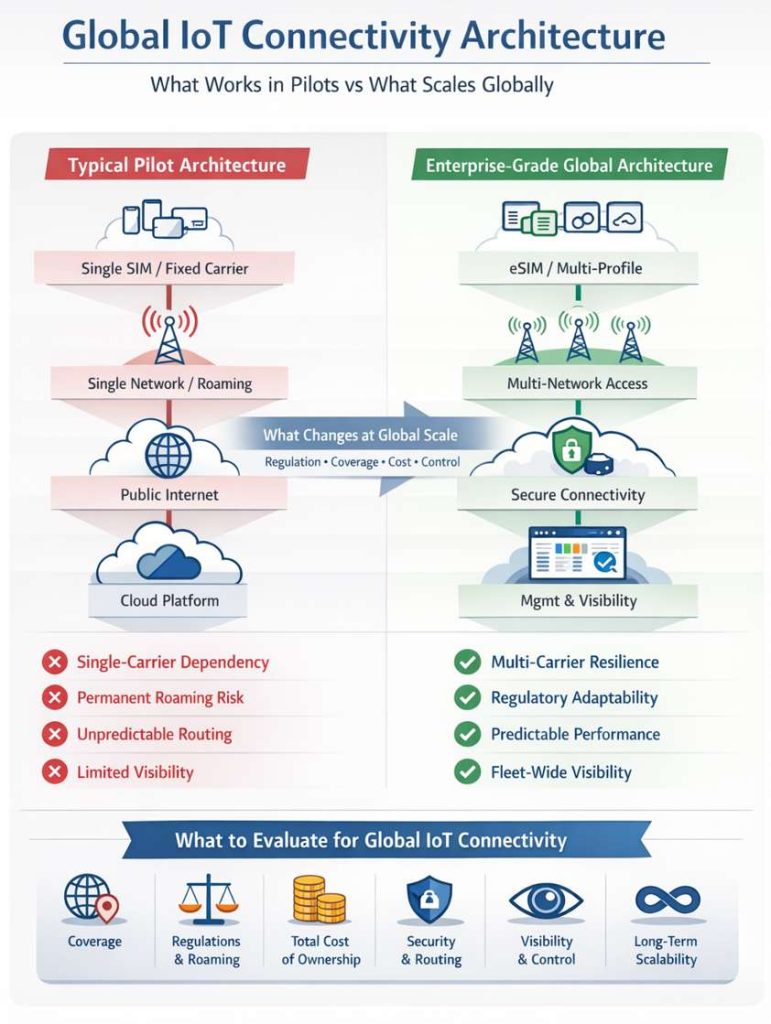
In Summary: What Good Global IoT Connectivity Looks Like
A future-proof global IoT strategy combines:
- Multi-network connectivity with carrier independence
- Remote eSIM provisioning & local compliance
- Centralized management with analytics and security
- Smart pricing (pooled/PAYG) and transparent billing
- Coverage tested across regions and technologies
These choices not only reduce cost and complexity but ensure your IoT devices stay secure, compliant, and online anywhere on Earth, from cities to deserts to oceans.