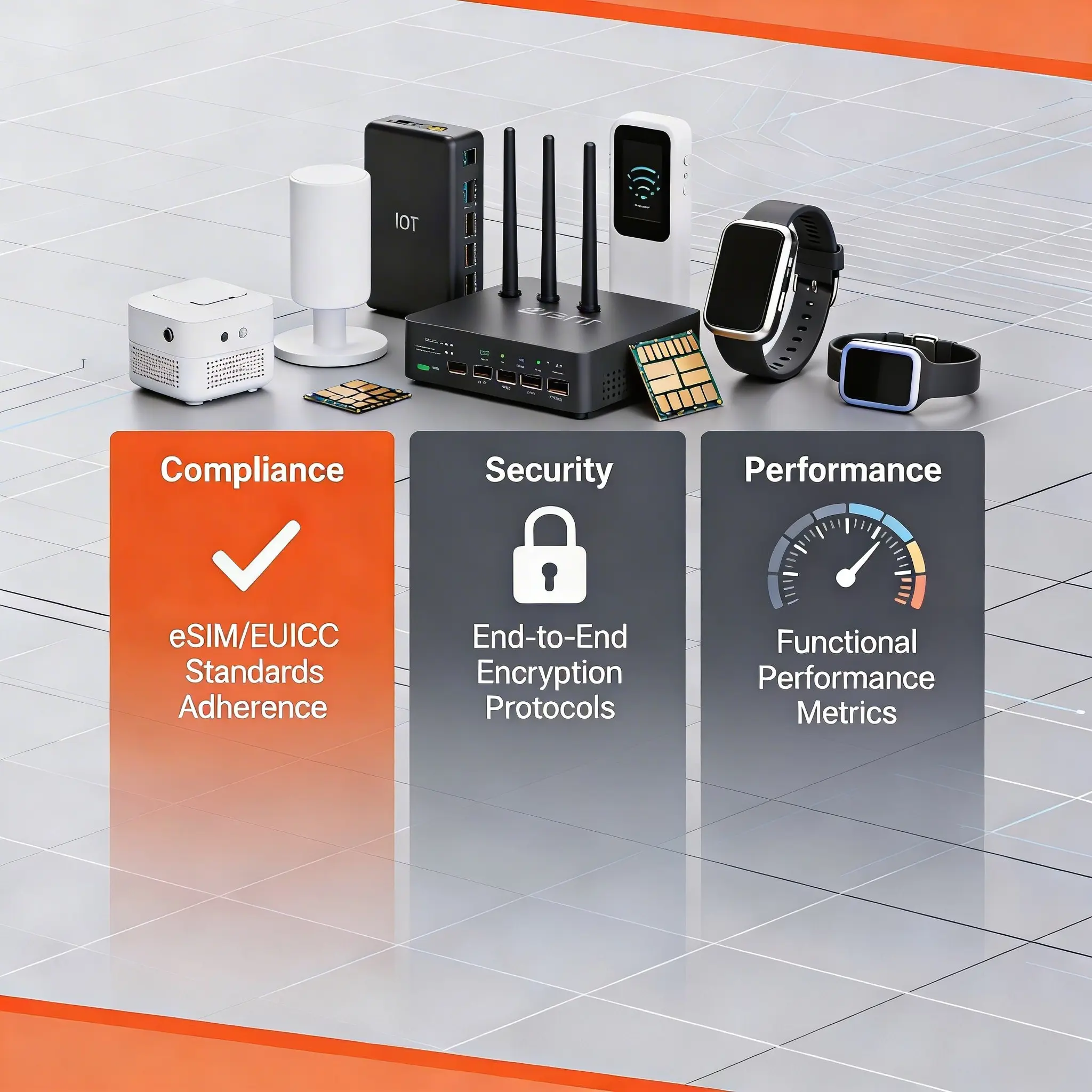
How eUICC, eIM architecture, and GSMA-certified platforms determine whether enterprise IoT deployments scale securely, or fail.
The global Internet of Things (IoT) ecosystem is undergoing a massive transformation. Enterprises across industries, from logistics and energy to fintech and smart cities, are rapidly deploying connected devices to enable automation, real-time data insights, and digital infrastructure.
However, as organizations scale deployments across multiple countries and mobile networks, a major challenge quickly emerges: connectivity management.
Traditional SIM card infrastructure was originally designed for consumer mobile devices such as smartphones. It was never built to support large-scale IoT deployments involving thousands, or even millions, of devices distributed across vehicles, smart meters, industrial equipment, payment terminals, and shipping containers.
In these environments, manually replacing SIM cards or managing separate mobile operator agreements in each country becomes operationally complex, costly, and often impossible.
To address this challenge, the telecommunications industry developed embedded SIM (eSIM) technology powered by embedded Universal Integrated Circuit Card (eUICC) architecture.
This technology enables organizations to remotely provision, activate, and switch mobile network operator profiles across connected device fleets without physically replacing SIM cards. By allowing remote connectivity management, eSIM technology has become a critical foundation for scalable global IoT deployments.
Yet despite the promise of this technology, a major issue has emerged in the market.
The Hidden Problem in the eSIM Market
The term eSIM has quickly become one of the most overused buzzwords in the telecommunications and IoT industries.
Many vendors promote “eSIM-enabled connectivity,” yet their platforms often fail to meet the strict security, interoperability, and remote provisioning requirements defined by the GSM Association (GSMA).
For enterprises deploying IoT devices globally, the difference between a GSMA-compliant eSIM infrastructure and a proprietary or non-compliant solution can determine whether a project scales successfully, or becomes a costly operational risk.
Non-compliant implementations may introduce serious challenges, including:
- Network lock-in, preventing devices from switching operators
- Security vulnerabilities due to weak provisioning frameworks
- Limited interoperability across mobile networks and regions
- Costly SIM replacements when connectivity profiles cannot be updated remotely
- Deployment failures in multi-country environments
These risks become especially critical for organizations deploying large IoT fleets across global markets.
Understanding the difference between true GSMA-compliant eSIM platforms and proprietary alternatives is therefore essential for companies building resilient IoT connectivity infrastructure.
The Evolution of SIM Technology
Traditional SIM Cards
For decades, mobile networks relied on removable SIM cards to authenticate devices and provide network access.
While effective for mobile phones, traditional SIMs present significant limitations for IoT deployments.
Challenges include:
- Manual installation and replacement
- Limited ability to switch operators
- Complex global logistics for SIM distribution
- High operational costs for large device fleets
These limitations drove the development of programmable SIM technologies.
eSIM and eUICC: The Foundation of Modern IoT Connectivity
What Is eSIM Technology?
An eSIM (embedded SIM) allows mobile network profiles to be installed and managed remotely, eliminating the need for physical SIM card replacement.
Instead of swapping SIM cards manually, organizations can remotely download operator profiles directly to devices.
This capability allows IoT deployments to:
- Activate connectivity remotely
- Switch networks over the air
- Manage global device fleets centrally
- Reduce field maintenance costs
At the heart of this technology is a secure hardware component called the eUICC.
What Is an eUICC?
The eUICC (embedded Universal Integrated Circuit Card) is the secure chip embedded within an IoT device that enables remote SIM provisioning.
Unlike traditional SIM cards, the eUICC can store multiple operator profiles simultaneously.
This allows devices to dynamically switch connectivity providers without replacing hardware.
Key capabilities include:
- Secure profile storage
- Multiple network profiles
- Remote installation and deletion of profiles
- Over-the-air updates
These features make eUICC technology foundational for large-scale IoT deployments.
Consumer eSIM vs IoT eSIM Architectures
Not all eSIM implementations operate the same way.
Two main architectures exist:
Consumer eSIM
Designed for smartphones, tablets, and wearables.
Users typically activate connectivity using:
- QR codes
- Carrier apps
- Manual profile switching
This architecture follows the GSMA SGP.22 standard.
IoT eSIM Architecture
IoT deployments require a very different model.
Devices often lack:
- screens
- keyboards
- user interaction
They may also operate in remote environments such as industrial sites, vehicles, or offshore infrastructure.
To support these scenarios, IoT deployments use architectures defined by:
- GSMA SGP.02 (M2M eSIM)
- GSMA SGP.32 (next-generation IoT standard)
These standards enable fully automated remote management.
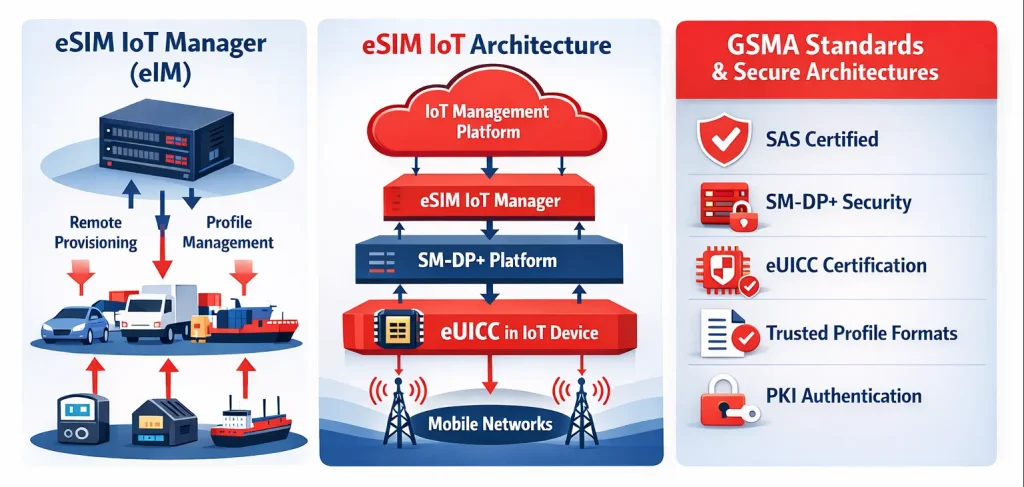
A key component is the eSIM IoT Manager (eIM).
Introducing the eSIM IoT Manager (eIM)
A major innovation in the new IoT architecture is the eSIM IoT Manager (eIM).
The eIM acts as a central command platform for managing eSIM connectivity across IoT device fleets.
Instead of managing SIMs individually, organizations can control thousands of devices from a single system.
What the eIM Enables
Using the eIM, enterprises can remotely:
- Install new operator profiles
- Remove outdated profiles
- Activate or suspend subscriptions
- Switch networks
- Manage connectivity policies
All operations occur securely through server-initiated commands.
This capability transforms how large IoT networks operate.
Why Compliance Matters
The GSMA developed strict standards to ensure the security and interoperability of the global mobile ecosystem.
Without these standards, devices could become incompatible with networks, vulnerable to security breaches, or permanently locked to a single provider.
A compliant eSIM ecosystem ensures:
- Interoperability across operators
- Strong cryptographic security
- Reliable global connectivity
- Long-term deployment flexibility
Mandatory Requirements for GSMA-Compliant eSIM Platforms
To operate within the GSMA ecosystem, platforms must meet several key requirements.
1. GSMA SAS Certification
Manufacturing facilities must comply with the Security Accreditation Scheme (SAS), ensuring secure production of SIM hardware.
2. SM-DP+ Certification
The Subscription Manager Data Preparation (SM-DP+) platform must be certified for secure profile delivery and lifecycle management.
3. eUICC Security Certification
The eUICC chip must meet internationally recognized security standards such as:
- Common Criteria EAL4+
- GSMA eSIM Security Assurance
4. Trusted Profile Formats
Profile packages must follow specifications defined by the Trusted Connectivity Alliance to ensure interoperability.
5. Secure PKI Infrastructure
Authentication within the ecosystem relies on X.509 certificate-based Public Key Infrastructure (PKI).
Risks of Non-Compliant eSIM Platforms
Platforms that fail to follow GSMA standards may introduce major risks.
These include:
- Vendor Lock-In: Devices may be permanently tied to a single operator.
- Security Exposure: Improper encryption methods may expose network credentials.
- Limited Network Compatibility: Devices may fail to operate across different carriers.
- Operational Inefficiency: Manual SIM replacements may still be required.
For global IoT deployments, these limitations can lead to major operational disruption.
Enterprise Use Cases
Compliant eSIM infrastructure supports numerous industries.
- Fleet & Logistics: Vehicles crossing borders can dynamically switch operators.
- Industrial IoT: Factories can deploy sensors globally with centralized connectivity control.
- Maritime Connectivity: Ships can switch between regional carriers depending on location.
- Smart Energy: Utilities can manage millions of meters remotely.
- Fintech & POS: Payment terminals maintain reliable connectivity by dynamically selecting available networks.
The Future of Global IoT Connectivity
The number of connected devices worldwide is projected to exceed 30 billion by the end of the decade.
As deployments grow, remote connectivity management will become essential.
Technologies such as:
- eUICC
- eSIM remote provisioning
- eIM orchestration
- multi-operator connectivity
will form the backbone of global IoT infrastructure.
How Fidelitel Supports Enterprise IoT
Fidelitel provides connectivity solutions designed specifically for enterprise IoT deployments.
Our platform focuses on:
- multi-operator connectivity
- eSIM lifecycle management
- global coverage
- remote profile provisioning
- secure standards-aligned architecture
By combining advanced SIM technologies with global carrier integrations, Fidelitel enables organizations to deploy scalable, secure, and resilient IoT connectivity worldwide.
Conclusion
As IoT adoption accelerates across industries, the ability to manage connectivity securely and at scale becomes a strategic priority.
Organizations evaluating eSIM solutions must carefully assess whether platforms adhere to GSMA compliance standards.
Only compliant platforms can ensure:
- secure connectivity
- global interoperability
- scalable device management
- long-term deployment flexibility
Enterprises that build their IoT infrastructure on compliant architectures today will be best positioned to scale globally in the connected economy.