What Are LPWA Networks?
Low Power Wide Area (LPWA) networks represent a class of wireless technologies designed for Internet of Things (IoT) devices that need long-range communication, very low power consumption, and cost-efficient connectivity across broad geographic areas. These networks are foundational to scaling connected sensors, meters, trackers, and automation systems where traditional cellular or Wi-Fi connectivity either isn’t practical or is too expensive.
Unlike broadband cellular technologies designed for high throughput (like 4G/5G), LPWA optimizes for efficiency, distance, and battery longevity, enabling devices to operate for years on small batteries.
Why LPWA Networks Are Critical for IoT Growth
Modern IoT ecosystems span cities, supply chains, utilities, and agriculture, environments where connectivity must be:
✔ Affordable at scale (low cost per device)
✔ Energy efficient (multi-year battery life)
✔ Wide ranging (coverage over rural, suburban, and indoor areas)
✔ Scalable and flexible (supporting thousands of devices)
That’s where LPWA shines: it makes large-scale IoT deployments economically feasible and operationally reliable without the power and data costs of traditional cellular or broadband.
Key Characteristics of LPWA Networks
LPWA networks are uniquely engineered for IoT requirements. Their primary characteristics include:
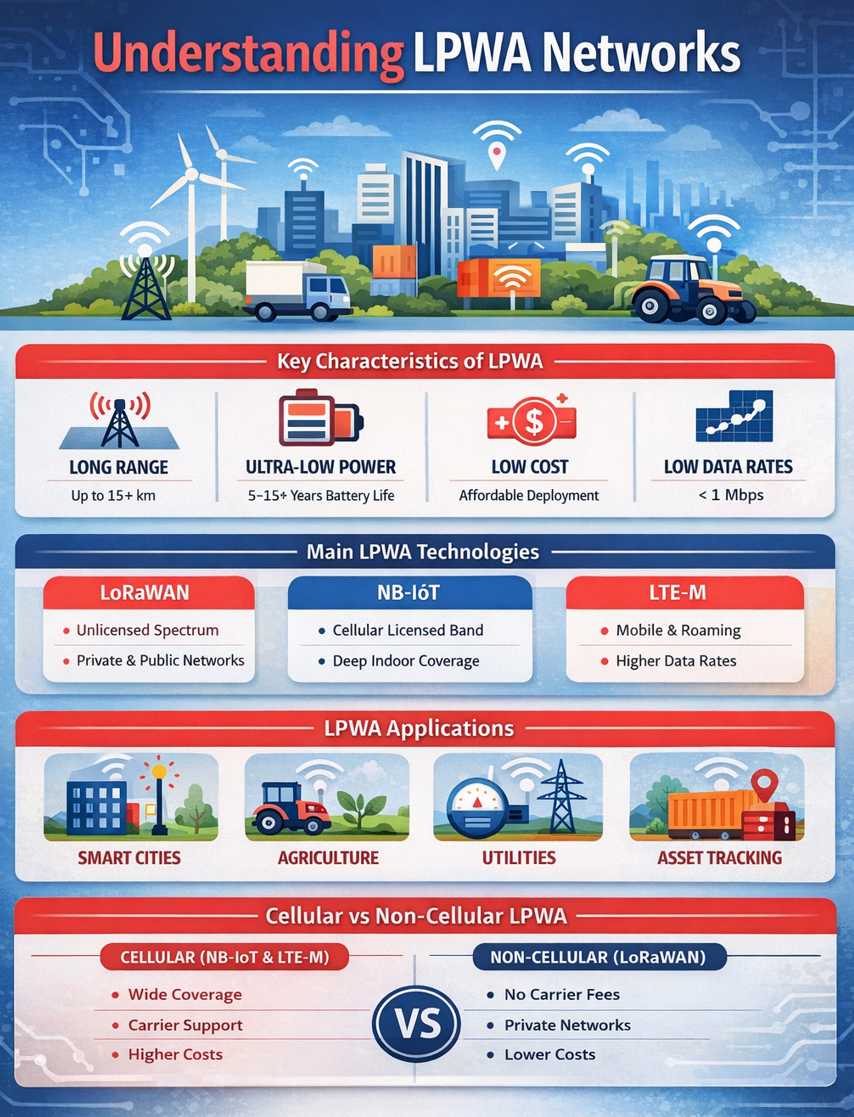
- Long-Range Communication: LPWA technologies can transmit signals from kilometers away, typically 2–5 km in urban areas and up to 15–20 km or more in open rural environments, without line-of-sight infrastructure.
- Ultra-Low Power : Devices using LPWA can run on small batteries for 5–15+ years, thanks to efficient protocols and sleep modes that minimize energy use.
- Low Cost: LPWA hardware modules and network rollouts are inexpensive compared to cellular infrastructure. Many LPWA technologies operate on license-free frequencies, avoiding spectrum fees.
- Low Data Rates: LPWA networks are optimized for small, periodic data, not high-volume payloads. Typical throughput ranges from 100 bps to 1 Mbps depending on the technology.
- Massive Device Support: LPWA architectures support large numbers of connected endpoints per gateway or cell, enabling smart city and industrial scale deployments.
LoRaWAN — Private and Public Unlicensed LPWA
LoRaWAN (Long Range Wide Area Network) is one of the most widely adopted non-cellular LPWA standards. It uses unlicensed ISM radio bands (e.g., 868 MHz in Europe, 915 MHz in the U.S.) and a star-of-stars architecture where devices connect to gateways that relay data to network servers.
Why LoRaWAN?
- Operates without carrier subscriptions
- Ideal for private and public deployments
- Long range with good obstacle penetration
- Low cost and highly scalable
- Supports deep indoor and underground communications
Typical Data Rates: ~0.3 kbps – 50 kbps
Battery Life: 7–15+ years
Best For: Smart cities, agriculture, environmental monitoring, utility metering, asset tracking.
LoRaWAN’s biggest advantage is flexibility, private networks and open standards let organizations customize deployments without relying on carriers.
NB-IoT — Licensed Cellular LPWA Standard
Narrowband IoT (NB-IoT) is a 3GPP standard designed to run on licensed cellular spectrum. It excels in applications needing reliable connectivity, deep indoor coverage, and robust infrastructure support.
Why NB-IoT?
- Strong mobile operator support and coverage
- Excellent building and underground penetration
- High connection density per cell (tens of thousands of devices)
- Integrated with existing LTE networks
Typical Data Rates: up to ~250 kbps
Battery Life: Up to 10+ years
Best For: Smart metering, utilities, smart buildings, industrial sensing, security systems.
NB-IoT is ideal where network reliability and regulatory compliance matter most, such as utilities and critical infrastructure.
LTE-M — Cellular LPWA with Mobility
LTE-M (also called LTE Cat-M1 or eMTC) offers a middle ground between traditional cellular and LPWA. It supports higher data rates, lower latency, and mobility, enabling reliable communication even when devices move between cells.
Why LTE-M?
- Better throughput than NB-IoT
- Suitable for mobile and roaming IoT devices
- Supports voice (VoLTE), firmware updates, and real-time applications
Typical Data Rates: Up to ~1 Mbps
Battery Life: Several years
Best For: Asset and vehicle tracking, wearables, point-of-sale devices, mobile IoT.
LTE-M expands LPWA’s reach into applications where motion and higher bandwidth are required.
Real-World LPWA Applications
LPWA networks power many practical IoT innovations:
Smart Cities
- Connected streetlights that report outages or adjust brightness
- Sensor-based parking availability systems
- Environmental monitoring (air quality, noise)
- Waste bin fill level tracking
Agriculture & Environment
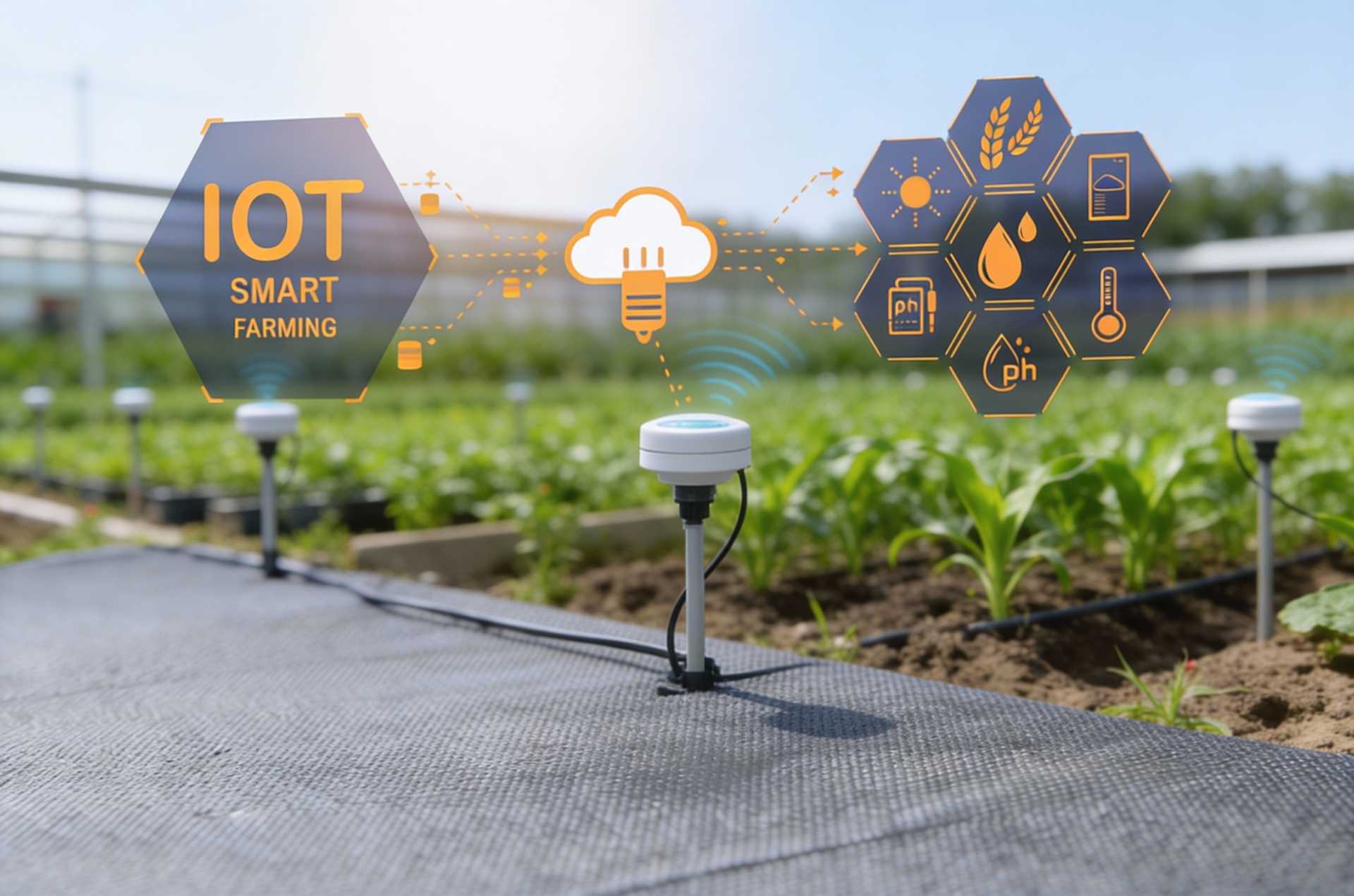
- Soil moisture and crop monitoring stations
- Livestock tracking and asset sensors
- Weather sensors feeding predictive analytics
Industrial IoT
- Predictive maintenance sensors on machinery
- Remote monitoring of pipelines and assets
- Safety sensors in hazardous facilities
Utilities
- Smart water, gas, and energy meters
- Grid performance and outage indicators
- Leak detection systems
Asset Tracking & Logistics
- Smart pallets sending position and condition data
- Fleet tracking for trucks and containers
- Cold chain visibility for temperature-sensitive goods
These applications demonstrate that LPWA is not just another wireless protocol, it’s the backbone for efficient, scalable IoT deployments across industries.
Cellular vs. Non-Cellular LPWA: Choosing the Right Fit
There’s no one-size-fits-all answer. The right LPWA technology depends on use case, geography, cost structure, and operational requirements.
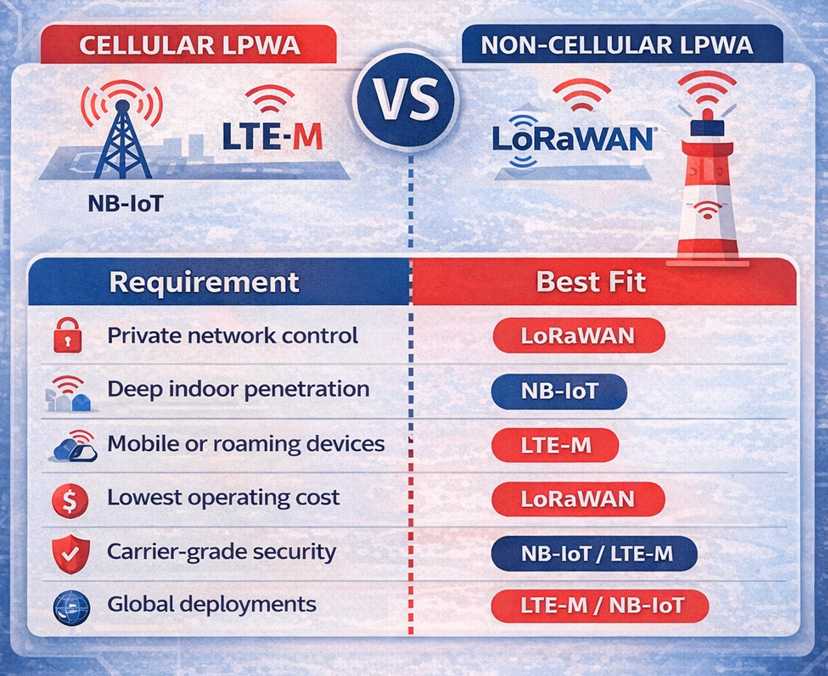
In many modern IoT architectures, hybrid LPWA strategies are becoming the norm, combining multiple technologies under a single management platform.
Cellular LPWA (NB-IoT & LTE-M)
- Pros: Wide coverage, deep penetration, carrier support, security and roaming.
- Cons: Subscription costs, sometimes higher power usage than unlicensed alternatives.
Best For: Business-critical IoT with global reach and high reliability.
Non-Cellular LPWA (LoRaWAN & others)
- Pros: No carrier fees, private network control, low deployment cost.
- Cons: Limited roaming, shared spectrum interference, variable regional coverage.
Best For: Local infrastructure, private IoT networks, smart cities, and cost-sensitive deployments.
Understanding these trade-offs is essential when planning any IoT strategy.
Future Trends — LPWA and Beyond
While 5G promises high speeds and new IoT slices, it will not replace LPWA for ultra-low-power, wide-area needs. Instead, 5G and LPWA will co-exist, with LPWA handling low-power, low-data applications while 5G tackles high-bandwidth tasks.
Emerging enhancements include hybrid deployments combining LPWA and cellular, AI-driven adaptive connectivity, and integration with edge computing for smarter, real-time IoT processing.
Conclusion — LPWA Is IoT’s Workhorse
LPWA technologies, especially LoRaWAN, NB-IoT, and LTE-M, are transforming how disparate devices communicate over long distances with minimal power and cost. Their role in smart cities, utilities, agriculture, logistics, and industrial IoT makes them indispensable to modern digital transformation.
Choosing the right LPWA strategy means aligning connectivity with application requirements: mobility, data throughput, network control, and deployment scale. With LPWA, businesses unlock real-world IoT value, faster, smarter, and more sustainably than ever before.